Showing posts with label book reviews. Show all posts

Tuesday, November 13, 2007

Book Review: National Geographic's Birding Essentials

National Geographic's Birding Essentials by Jonathan Alderfer and Jon L. Dunn bills itself as having "all the tools, techniques, and tips you need to begin and become a better birder." This book is in the same vein as Sibley's Birding Basics and Jack Connor's The Complete Birder.

From a design perspective, this book differs from Sibley and Connor by the use of photographs, as opposed to Sibley's drawings or Connor's limited sketches. The photos, provided by some of the best bird photographers around, are outstanding and, for the most part, convey the material in the book effectively.

"Essentials" is broken down into 8 major sections "Getting Started", "Status & Distribution", "Parts of a Bird", "How to Identify Birds", "Variation in Birds", "Identification Challenges", "Fieldcraft", and "Taxonomy & Nomenclature". These basically cover all the bases of the other books mentioned above, in some cases as an equal and in others not as much.

The "Getting Started" section covers the bases such as optics, field guides, and note taking sufficiently. "Status & Distribution" is pretty straightforward. It defines these terms and discusses how they can be used while birding to learn what to expect where and when and also what may be rare.

"Parts of a Bird" really gets down into the nitty gritty. The authors do a terrific job showing and explaining the parts of various different birds including gulls, ducks, shorebirds, sparrows, and raptors. This was a strong point of Sibley's book and tough to top. I prefer the line drawings that Sibley used because they allow you to truly see the different groups of feathers. Although, I prefer the detailed explanation of Birding Essentials.

"How to Identify Birds" takes you through the steps of identification through specific case studies. Topics include judging size, shape, plumage, behavior, and vocalizations. The case studies chosen are perfect. For example, Blue Grosbeak vs. Indigo Bunting is used as an example for judging size and Swainson's Hawk vs. Red-tailed Hawk is used for shape. Some topics include multiple examples. This section of the book really shines and I can see a beginner birder gaining a lot of insight from it.

Next is the "Variation in Birds" section which covers some of the more confusing areas of birding, namely molt, age variation, and feather wear. I've spoken to many advanced birders who tell me that they use Sibley's Birding Basics as a reference for molt and age variation. Birding Essentials does a comparable job explaining these topics, but could use a few more pictures for examples.

"Identification Challenges" discusses the challenges that many other books have tackled before such as terns, female mergansers, and pewees vs. empids. They are brief, to-the-point explanations that don't include photos in all instances. While these will introduce a beginner quickly to some of the challenges they can expect in the field, they are better covered elsewhere in books like The Complete Birder and Identify This.

The "Fieldcraft" section discusses the "how," "where," and "when" of birding. It's well-written, but perhaps should have been placed earlier in the book. The same goes for the "Taxonomy & Nomenclature" section. One big complaint I have is that the authors frequently use family names like "Alcid" and "Emberizid" freely before even covering them in this last section of the book. I fear that complex terminology like this can push away a beginner.

Even as an experienced birder, I enjoyed reading Birding Essentials. I learned a few things and found the photos outstanding. While the book doesn't have the casual and accessible language of Jack Connor's classic or the artistry of Sibley, Birding Essentials makes a perfect gateway for a person who is looking to go from a casual bird observer to a full-fledged birder.

Tuesday, July 03, 2007

Review: The Birds of Costa Rica: A Field Guide

Costa Rica is an extremely popular destination for birders in the tropics, so it's surprising that the only good field guide that's been available was published in 1989. A Guide to the Birds of Costa Rica by F. Gary Stiles and Alexander F. Skutch is a classic, but unfortunately a lot has changed in Costa Rican birding in the last 18 years. There have been splits, range expansions, and name changes galore making Stiles and Skutch (S&S) difficult to use without a bunch of handwritten notes.

Finally, a new field guide dedicated to Costa Rica was published in May - The Birds of Costa Rica: A Field Guide by Richard Garrigues and Robert Dean. Garrigues and Dean (G&D) are two of Costa Rica's top birders and they've really come through with a book "for birders, by birders."

The first thing I noticed about the book was its size and portability. It's compact and about the size of the National Geographic North America guide. This is a big change from S&S which is a very large book due to its inclusion of natural history information (habits and nesting) for each bird. On my two trips to Costa Rica, the size of S&S was always a pain because it was usually packed away in someone's backpack. On the flip side, G&D is extremely portable, but lacks the natural history information on each bird so you may want to keep your S&S around.

The book is organized like most traditional field guides. There is a brief introduction on how to use the book and then it jumps right into the birds. Each section starts with a short paragraph describing the family. Each bird is illustrated in fantastic detail in all of its adult plumages. Each entry is accompanied by a description of the bird with key field marks in bold. Range information, a description of the vocalizations, and a notation if the bird is endemic are also included. The biggest leap from S&S is the inclusion of a range map next to each entry. These can be compared to a detailed map of Costa Rica in the front cover.

One thing that confused me at first was the scale of the drawings on each page. Each drawing is to scale with the other drawings on the page, but some pages include one or more drawings that are of a different scale. These drawings are separated from the others by a black line. This took some getting used to. Also, you have to keep this scale in mind because one page of Empidonax flycatchers may have 6 large drawings and the next will have 12 small drawings even though the birds are the same size in life.

The back of the book includes a helpful glossary of terms, an extremely informative summary of taxonomic changes from S&S, a complete list of Costa Rican birds including a few not illustrated in the book, an index, and 2 plates of raptor flight illustrations. The list of Costa Rican birds could have been left out and saved 7-8 pages or it could have been used as a checklist instead. Also, I don't know why the raptor flight plates were included here and not in the raptor section. I guess it makes a nice quick reference, but it just seemed strange.

Overall, this book easily replaces Stiles and Skutch in the field. If you already own S&S, you will want to use this as a reference for natural history information, but you can leave it home when venturing out into the rainforest. I salute Garrigues and Dean for their hard work on what is surely a labor of love. I'm excited to go back to Costa Rica someday to really use the book in the field.

Sunday, June 17, 2007

Book Review: Wildflowers in the Field and Forest

Last year, the "Through Binoculars" series by Oxford University Press published Wildflowers in the Field and Forest: A Field Guide to the Northeastern United States by Steven Clemants and Carol Gracie. Beth and I bought it at the tail-end of the wildflower season, so we didn't get to make much use of it. Recently, I finally sat down and really looked through it and also used it to ID some plants.

The introduction of the book discusses the structure of flowers, some terminology, and wildflower gardening. The authors also introduce the identification key. A plant field guide is only as good as its key. The key uses color and plant structure to narrow down your choices. Your initial choices take you to a specific set of species accounts where additional features help you narrow your choice (hopefully) to your final answer.

The species accounts use photos as opposed to illustrations found in other popular guides like Newcomb's Wildflower Guide and Peterson Wildflower Guide. For the most part, the photos are crisp and each shows a small line dictating the actual size of the flower. Many photos have inset photos showing leaf shape or other important features. The descriptions of the flowers are short and to the point. They describe all of the parts of the plant and the key features are bolded. Endemic and non-native plants are labeled accordingly. (And in this author's opinion, there are too darn many non-natives!)

A key feature that sets this book apart from other wildflower guides is the range map included with each entry. Most other books include descriptions of range, but don't get as detailed as these maps. The maps are also color coded to indicate blooming season (Spring, Spring-Summer, Summer, Summer-Fall, Fall, Spring-Fall).

Despite these great features, this book does have a few flaws. First, there are many terms used in the descriptions of the plants that are not properly defined in the glossary or elsewhere in the book. I was forced to reference other books in order to understand these terms. Second, it seems that the book was rushed to print. There are some typos and some page references that are missing page numbers (it says "p. xxx" instead of a number). Third, some of the plant names, both common and scientific, are different from other books. This is by no means a problem with this book specifically, but a problem as a whole for any book dealing with plants. There is a constant change in naming as scientists learn more about each plant. Plants with scientific names that have changed are listed under both names in the index, but do not have those same references in the species accounts. It would have been helpful to include that in both places. Finally, the book is printed on glossy paper for the photos which does make it a bit heavier than other guides. To me, it's not a big issue, but some may feel otherwise.

Overall, this book is a great addition to any naturalist's library. Until I use this book more, I'm not sure if I can give up my Newcomb's guide 100%. With the range maps and photos in this book combined with the detailed illustrations in Newcomb's, I have a great one-two punch for identifying almost every wildflower I encounter.

Wednesday, May 23, 2007

Book Review: The Complete Birder

Birders can argue ad nauseum regarding the "must have" books for any new birder. Aside from preferred field guides, my argument would include several supplemental books. At the top of that supplemental list are Sibley's Birding Basics and Jack Connor's The Complete Birder: A Guide to Better Birding.
Back when I was a fledgling birder, I bought Connor's book for a whopping $4 from a store that was going out of business. What a steal! I read it from cover to cover, but at that time, I didn't appreciate some of the advanced birding tips the author gave. Over the years, I have repeatedly reviewed the book and have learned new things each time.

The Complete Birder covers a range of topics for the beginning and advanced birder. As a beginning birder, the author introduces topics such as bird biology, migration, optics, weather, and feather molt. Connor's friendly and humorous writing makes these sometimes confusing topics very accessible to a beginner. After introducing birders to the "required topics", Connor highlights birding throughout the seasons. He stresses the importance of knowing what birds to expect when. For example, he talks about Catharus thrushes in the winter and how you are most likely going to see a Hermit Thrush vs. any of the others. He also highlights buteos and terns in a similar manner.

As a birder becomes more advanced, the remaining chapters of the book are extremely beneficial. The common challenges of bird identification are given their own chapters: raptors in flight, shorebirds, terns, gulls, and warblers. Here's where Connor's book really shines. Each chapter breaks down these challenges into smaller, manageable chunks - separating shorebirds into "peeps" and "plumps" and by habitat, small vs. medium vs. large terns, etc. Each chapter also features supplemental charts and keys that can be used to separate problem species. For example, he has a key for separating fall Blackpoll and Bay-breasted Warblers. Using a simple list of "yes/no" questions (color of legs, streaking, presence of "bay" on the flanks), he breaks down this difficult id puzzle into simpler terms. He uses similar aids for separating buteos in flight, sorting through shorebirds, and identifying gulls. Comparing this content to Kaufman's Advanced Birding, the text in Connor's book is less technical and more conversational. It doesn't include as many sketches as Kaufman's book does though. (As an aside: I think both are required books for the advanced birder!)

The Complete Birder is a must read for anyone seriously interested in birding. The content covered helps turn a novice birder into a more advanced birder. Connor's conversational writing and humorous anecdotes make it a difficult book to put down. If I have one complaint about the book, it's that it has a slight northeastern slant due to the author's home territory. This doesn't draw away from the rich content included within.

And the fact that you can get this book for less than $2 used on Amazon is awesome...

Let me know if you've read this book and what you think of it.

Friday, March 09, 2007

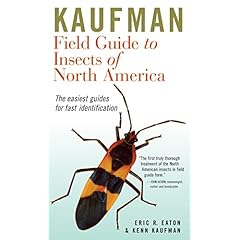
Book Review: Kaufman Field Guide to Insects of North America

I recently picked up the much anticipated Kaufman Field Guide to Insects of North America by Kenn Kaufman and Eric Eaton. Since the book can't obviously show the 1000's of insects in the US and Canada, it aims to show all of the orders and families of insects and some of the more common species you might see. Each section gives a description of the order and then more detailed descriptions of each family within that order. The descriptions include general shape and physical characteristics, lifecycle information, food preferences, environmental impact, and the number of species that occur north of Mexico. Unlike the Peterson Field Guide to Insects, this guide does not provide a key for identifying a given insect to the family level. The individual species that they chose to highlight are described with some generic descriptions, usually including details on broad range, behavior, and feeding habits. Fun facts and tidbits are included when possible. While interesting to read, these descriptions don't give much in the way of identification. The identification aspect of this guide is left up to the photos. The photos are the bread and butter of this guide. They are crisp, gorgeous, and sufficiently sized for use. Similar to Kaufmann's other guides, a silhouette is printed on each page to act as a scale for size comparisons.
The biggest complaints that I've heard from others is the lack of distribution maps and definitive information on how to find different species. I can understand why the authors didn't include distribution maps. They wouldn't have added much value since this is not a true "field guide" in the sense of the term. As the authors mention several times, there are guides dedicated to the individual orders and families that can provide this information. As far as information about how to find some of the species, the authors mention things like "may come to lights at night" or "found in moist deciduous forests". Again, this information can be found elsewhere.

For someone interested in identifying their backyard insects or for someone looking to learn more about insects in general, this guide is sufficient. If you're interested in identifying every insect you find to the family-level, the Peterson guide is the way to go because it includes a key. Your best bet would be to use this guide as a supplement.

Monday, October 02, 2006

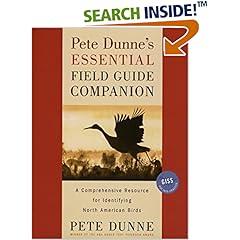
A Dunne Deal: A Review

Pete Dunne's latest tome, Pete Dunne's Essential Field Guide Companion, has been reviewed several times by various bloggers already including here, here, and here. After receiving this book for a birthday present a few weeks ago, I thought I would throw my $.02 in.

As everyone knows, this book has no photos. I'm ok with that. I understand that the point of the book is to explain the "Cape May School" of birding, otherwise known as the "GISS" method. I think the book accomplishes its goals with some minor flaws. As a somewhat experienced birder, I think the most useful purpose for this guide is to learn some of the nuances of the more difficult to separate species such as the Empidonax and Myiarchus flycatchers, kingbirds, Catharus thrushes, gulls, fall warblers, etc. Learning to distinguish these species can help advance a birder's field skills immensely. Pete's detailed descriptions of the species are a true companion to your Sibley guide. You can sit with your field guide by your side and read the descriptions and really see the differences. Also, some of the species accounts have a section called "Pertinent Particulars" that I found especially useful. This section gives helpful hints on distinguishing the bird from similar species or just some general tips on identifying it.

My biggest complaint about the book are the silly names that Pete has given to some of the birds. Some of them are useful, but some seem like he was trying too hard to find a name for the bird or the name seems very personal to the author. The Ninja Heron for Tricolored Heron? Twig Fairy for Blue-gray Gnatcatcher? Peterson's Woodpecker for Northern Flicker? "A Busy, Jerky, Single-minded Little Bird" = American Pipit. Huh?

My only other complaint is the length of the book. If it truly is a field guide companion then he possibly could have left out the range descriptions completely or at least shortened them. That information can easily be found in a field guide.

I salute the intent behind this book and all of the work that Pete Dunne put into it. I'm sure I will be referencing it periodically.